A supplement that's supposedly working from the inside often doesn't touch what's sitting on top of the nail. That question sat with me longer than I want to admit before I built out a proper foot-care routine and kept testing supplements around it. A natural antifungal soak turned out to be the missing half, not a replacement for what you're swallowing, but support work for reaching toenail health a capsule can't touch on its own, useful only while the real fix is already running underneath it.
Five years of steel-toe boots and thick socks will do that to a guy, you stop looking at your own feet, let alone anyone else's business. Somewhere in there I started keeping a notebook; how a fungal nail actually progresses over time is a long story with its own tracking system, and I've laid that out separately rather than cramming it in here. What matters for this piece is one specific problem: once a fungal nail gets thick enough, nothing taken by mouth reaches the parts that need it. The nail turns into a lid.
My wife caught it before I did. She paused at the bathroom door one morning while I had my phone propped against the mirror for the weekly photo, the tile cold under both our feet in that flat, unflattering morning light, and pointed at my left little toe like something about it had changed. I hadn't looked closely enough myself to notice.
Why a Thick Nail Blocks Everything Else
Toenails don't grow fast under the best conditions, and the average monthly growth rate doesn't speed up because you're frustrated with it. A fungal infection makes the nail thicker instead of thinner, so whatever's circulating in your blood from a supplement has a harder path to the nail bed. Whether pills or oils get there faster is a different argument than the one I'm making here, either way, something still needs to soften the barrier sitting on top.
How Much Vinegar Actually Works
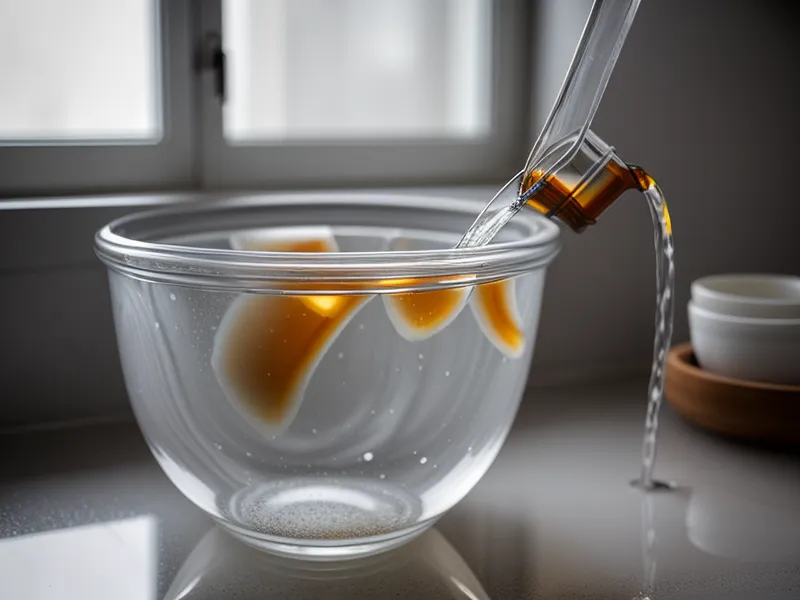
Distilled white vinegar and warm water, mixed at roughly one part vinegar to three parts water, is where I landed after starting stronger and regretting it. Go much stronger and the skin around the nail gets irritated fast. Go much weaker and it does nothing you'd notice. The Acetic acid in plain vinegar is doing the work, and you don't need a specialty foot-soak blend to get it, the bottle from the grocery store works the same as anything marketed specifically for toenails.
Soaking every night sounds like the aggressive move, and it's the mistake I made early on. Keeping your feet damp for long stretches doesn't help, it just gives Dermatophytes a damp environment to sit in between soaks, which cancels out whatever good the soak just did. Three nights a week, with full drying in between, is the frequency that actually moved things. Cutting the nail back as far as possible before I'd even started soaking was another early mistake; less nail seemed like it should mean faster results, but trimming aggressively before the nail had softened just left the edges cracked and sore, without changing how anything absorbed.
My neighbor Sheryl asked how the vinegar thing was going last week, and she remembered details about it I'd already forgotten telling her; she's like that, somehow tracking my own routine better than I do.
Tea Tree Oil, Without the Guesswork
Tea tree oil goes into the soak after the vinegar step, not instead of it, roughly ten drops in a full basin along with a scoop of Epsom salt. Quality varies more between bottles than people assume, and knowing which claims on a label are a red flag is worth learning before you spend money on any of it, though that's its own checklist I keep separate from this one. Exactly which compounds are supposedly doing the work is a deeper rabbit hole than I'll get into here.
What I can tell you is what it felt like: a deep, steady tingling in the nail bed about twenty minutes into the soak, different from anything a plain vinegar bath on its own produced. It wasn't unpleasant, just noticeable enough to make you think something was actually happening under there.
This is also where the soak connects to whatever supplement you're already running. I've laid out separately why ProNail Complex is better for warehouse workers with sweaty feet, and pairing a soak with that kind of targeted supplement is where I saw the biggest shift, not from the soak alone, and not from the pills alone. Which specific supplement brand wins in a straight head-to-head is a different question than this one.

Getting the Nail Ready Without Overdoing It
Once the nail actually softens instead of sitting there rock-hard, trimming it back becomes possible without pain. That's a technique with its own right and wrong way to do it, and I've broken it down elsewhere rather than cramming it into this piece.
What happens after the soak matters just as much as the soak itself. Feet need to be completely dry before socks or boots go back on, not damp-dry, actually dry, corners included. A hair dryer on the cool setting gets into spaces a towel misses, and skipping that step undoes half of what the soak just did. The rest of the reinfection picture, socks, shoe rotation, locker-room habits, is a longer routine I've covered on its own.
None of this requires anything exotic. Distilled vinegar, Epsom salt, and a decent bottle of tea tree oil come from the same trip to the Kroger on Canton Road in Marietta, no specialty store necessary, no premium soak kit required.
A Natural Antifungal Soak Fits Into a Bigger Foot-Care Routine
My neighbor Gail mentioned at the mailbox that her husband Doug picked up the same Sunday photo habit I use to track all this, how I actually run that system is a separate write-up of its own. Knowing Gail, she also worked in exactly what he'd spent on his tea tree oil before I could even ask, though I couldn't tell you the number myself.
Not every discolored nail is even the same type of fungal issue, and telling them apart is a skill of its own I've written about separately.
Diet plays into this too, more than people assume, though that's a separate factor I won't unpack here.
Laser treatment is the other route people bring up once soaks and supplements feel too slow, and whether it's worth the expense is a different conversation entirely.
Sticking with any of this long enough to see something happen is arguably harder than getting the vinegar ratio right. If you want more of what's worked for me, I've put together my best natural remedies for toenail fungus based on actual notebook results.
A soak won't fix a fungal nail by itself, and it was never supposed to. Treat it as the delivery system that lets everything else you're already doing actually reach the problem, keep it consistent, and keep your feet dry when you're done.