Look, I've spent two years buying nail fungus supplements one bottle at a time and writing down what happened in a cheap spiral notebook -- date, dose, what my toenails looked like that Sunday. Somewhere in year two I started actually reading the studies printed in tiny font on the back of a couple bottles, and a few of the numbers didn't add up when I checked them myself. My wife found me at the kitchen table one night, laptop open, comparing a supplement label against the actual research paper it claimed to be quoting. That's basically how this page happened. Every ingredient below is one I've swallowed, rubbed on a toe, or at least seen show up on a label I was about to buy -- and every number next to it is one I went and confirmed against the original study instead of trusting the bottle. For what it's worth, the topical antifungal cream my podiatrist prescribed did almost nothing after four months, which is exactly the kind of underwhelming result a supplement label will never print on the front.
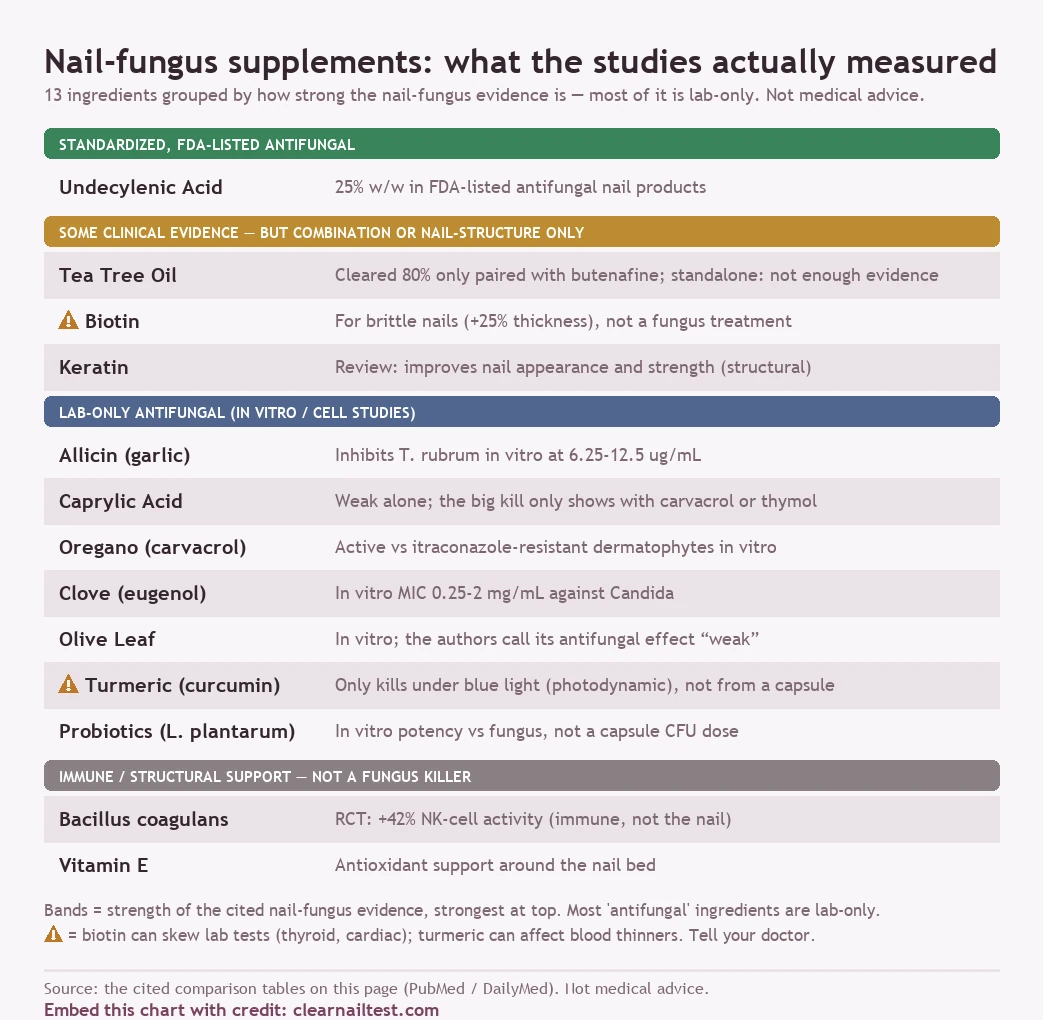
The honest read on the nail-fungus aisle: only one ingredient here — undecylenic acid at 25% — is a standardized, FDA-listed antifungal. Tea tree oil only cleared fungus when paired with butenafine cream; on its own, the evidence isn't there yet. Biotin and keratin are about nail structure, not fungus. And nearly everything else — allicin, oregano, clove, olive leaf, curcumin — has only been tested in a petri dish, not on a toenail. A lab win isn't a cure.
Direct Antifungal Agents
This first batch is what the labels call "direct antifungals" -- the ingredients doing the actual attacking, at least on paper. Below is what the studies actually measured, not what the marketing copy promises.
| Ingredient | Origin / Type | Primary Mechanism | Key Compounds / Concentrations |
|---|---|---|---|
| Undecylenic Acid | Fatty Acid (Castor Oil derivative) | Inhibits fungal growth by disrupting the cell membrane and preventing the transition from yeast to mycelial forms. | Commercial "maximum strength" antifungal liquids and nail pens on file with the FDA are standardized at 25% w/w undecylenic acid [DailyMed]. |
| Caprylic Acid | Medium-Chain Fatty Acid (Coconut Oil) | Disrupts fungal cell membrane integrity and inhibits efflux pumps [PubMed] -- though that's mostly the story when it's paired with carvacrol or thymol. Caprylic acid tested alone in the same study capped out at a 0.6-log reduction; the dramatic 6.8-log kill only showed up in combination. | Alone: membrane damage in 15.7-36.5% of cells, efflux-pump inhibition in 15.4-31.3% of cells. In combination with carvacrol/thymol: membrane disruption in over 83.1% of cells. |
| Allicin (Garlic Extract) | Organosulfur Compound | Reacts with thiol groups on antifungal-relevant enzymes, including thioredoxin reductase [PubMed]. | Against Trichophyton rubrum hyphae specifically, pure allicin inhibited growth at 6.25-12.5 µg/mL under electron microscopy -- well below the 2-4 mg/mL of raw garlic extract needed for a comparable effect [PubMed]. |
| Probiotics (e.g., L. plantarum) | Beneficial Bacteria | Metabolites in the bacterial supernatant -- mainly L-lactic acid and acetic acid -- inhibit dermatophyte growth [PubMed]. | L. plantarum strain HT-W104-B1 supernatant inhibited T. rubrum in vitro with a MIC of 20 mg/mL, IC50 of 14 mg/mL, and fungicidal concentration of 30 mg/mL. That's potency data against fungus, not a CFU dose for a capsule -- those are two different units and shouldn't be mixed up. |
Supportive and Structural Nutrients
This next group isn't attacking anything -- it's more like reinforcing the nail itself or nudging your immune system, the way adding insulation doesn't put out a fire but might help the house hold heat while you deal with it.
| Ingredient | Nutrient Class | Primary Mechanism | Key Figures / Findings |
|---|---|---|---|
| Biotin | Vitamin (B7) | Serves as a coenzyme for carboxylase enzymes involved in the synthesis of keratin, the primary protein in nails. | In the original biotin/brittle-nail electron-microscopy trial, nail thickness increased significantly by 25% in the group whose biotin dosing lined up with their nail-clipping schedule, and by 7% in a group where the timing didn't fully match [PubMed]. |
| Keratin | Structural Protein | Solubilized keratin is one of a handful of ingredients -- alongside biotin, collagen peptides, and choline-stabilized orthosilicic acid -- that a 2025 dermatology review lists as shown to improve the clinical appearance, strength, and brittleness of nails [PubMed]. | Often included as "solubilized keratin" (sometimes paired with MSM) to improve bioavailability in oral supplements. |
| Bacillus coagulans | Spore-forming Probiotic | Modulates systemic immunity by enhancing Natural Killer (NK) cell activity and IgA production [PubMed]. | A randomized, placebo-controlled trial of B. coagulans SNZ 1969 at 2 billion CFU/day for 12 weeks found a net increase of 42.07% in NK cell activity versus placebo, plus significant gains in serum and salivary IgA. |
| Vitamin E | Antioxidant | Protects nail matrix cells from oxidative stress and supports skin barrier repair around the nail bed. | Typically found as d-alpha-tocopherol in supplement labels. |
Botanical and Essential Oil Extracts
Last batch is the plant-oil stuff -- tea tree, oregano, clove, the ones that smell more like a kitchen cabinet than a medicine cabinet. Some of it holds up under a microscope. Some of it is weaker than the label makes it sound, and I'm not going to pretend otherwise.
| Ingredient | Active Compound | Primary Mechanism | Standardization / Usage |
|---|---|---|---|
| Tea Tree Oil | Terpinen-4-ol | Exhibits antimicrobial activity by damaging fungal cell membranes [Healthline], though a 2022 review of the existing studies found there isn't yet enough evidence to call it an effective standalone treatment [Healthline]. | Generally considered safe topically at concentrations under 15%, diluted in a carrier oil. A small 1999 trial combining 5% tea tree oil with 2% butenafine cream cleared toenail fungus in 80% of users after 8 weeks; nobody in the placebo group cleared theirs. |
| Oregano Oil | Carvacrol | Induces calcium stress and inhibits the TOR nutrient-sensing pathway in fungal cells, a different mechanism than simple membrane disruption [PubMed]. | An essential oil standardized to 73.9% carvacrol was active against itraconazole-resistant dermatophytes in a veterinary isolate panel, acting by complexing with fungal ergosterol in the cell wall and membrane [PubMed]. |
| Olive Leaf Extract | Oleuropein | Reduces membrane sterol content and inhibits the fungus's own virulence enzymes (SAPs) rather than working through a general immune boost [PubMed]. | MIC of 12.5 mg/mL against Candida albicans in vitro. A separate 2024 study found oleuropein's antifungal effect is concentration-dependent and, in the authors' own words, "weak" compared to its antibacterial activity -- no effect on Aspergillus niger at 0.2%, only partial reduction at 0.6% [PubMed]. |
| Clove Oil | Eugenol | Binds to ergosterol in the yeast cell membrane, causing leakage of intracellular components [PubMed]. | Minimal Inhibitory Concentrations (MIC) for Candida species range from 0.25 to 2 mg/mL. |
| Turmeric (Curcumin) | Curcuminoids | Induces nitrosative and oxidative stress that kills Trichophyton rubrum in lab testing -- but only when activated by blue light (417nm) at 10 J/cm², using a curcumin concentration of 10 µg/mL [PubMed]. | This is a photodynamic-therapy mechanism studied under lab light exposure, not something swallowing a curcumin capsule triggers on its own. |
I'm not a doctor, a dermatologist, or a podiatrist -- just a warehouse guy with a notebook full of toenail photos who got tired of labels that don't match the research they cite. This page is informational, not medical advice, and it's not a substitute for talking to your own doctor or podiatrist, especially if a nail is getting worse instead of better. Two things worth flagging to whoever prescribes your medication before you add any of this to your routine: turmeric/curcumin supplements can affect how blood thinners work, so mention it if you're on one, and high-dose biotin is known to throw off certain lab tests (thyroid panels, some cardiac markers), so tell your doctor you're taking it before your next blood draw.
Last verified: 2026-07-12
Sources
- DailyMed (NIH/NLM): Undecylenic Acid 25% Antifungal Nail Pen -- Structured Product Label
- PubMed: Bae & Rhee (2019) -- Short-Term Antifungal Treatments of Caprylic Acid with Carvacrol or Thymol
- PubMed: Ankri & Mirelman (1999) -- Antimicrobial Properties of Allicin from Garlic
- PubMed: Aala et al. (2014) -- Inhibitory Effect of Allicin and Garlic Extracts on Growth of Cultured Hyphae
- PubMed: Danial et al. (2021) -- Lactobacillus plantarum HT-W104-B1 for Control of Trichophyton rubrum
- PubMed: Zaraa & Richert (2025) -- Nail Supplements: When, How, and Why?
- PubMed: Murthy et al. (2025) -- Immunomodulatory Effects of Bacillus coagulans SNZ 1969 (RCT)
- Healthline: Tea Tree Oil for Nail Fungus -- Effectiveness and Safety
- PubMed: Rao et al. (2010) -- Mechanism of Antifungal Activity of Terpenoid Phenols
- PubMed: Waller et al. (2023) -- Oregano Essential Oil Against Itraconazole-Resistant Dermatophytes
- PubMed: Zoric et al. (2016) -- Antifungal Activity of Oleuropein Against Candida albicans
- PubMed: Al-Rimawi et al. (2024) -- Antibacterial and Antifungal Properties of Oleuropein
- PubMed: Biernasiuk et al. (2022) -- Clove Essential Oil and Eugenol as Natural Antifungals
- PubMed: Baltazar et al. (2015) -- Trichophyton rubrum Inhibited by Curcumin After Photodynamic Activation
- PubMed: Colombo et al. (1990) -- Treatment of Brittle Fingernails and Onychoschizia with Biotin